Wednesday, January 4, 2012

Romney Nips Santorum in Iowa Showdown


By Martha T. Moore and Carolyn Pesce, USA TODAY
CONCORD, N.H. – Iowa caucus winner Mitt Romney campaigned in New Hampshire on Wednesday, as attention shifted to a two-man race after Rick Santorum's explosive rise and near win in the first contest for the presidential nomination.


Romney won Iowa's Republican presidential caucuses by the narrowest of margins, the state's party chairman declared early Wednesday, finishing eight votes ahead of Santorum.  Michele Bachmann, who came in sixth, ended her campaign. Texas Gov. Rick Perry, who came in fifth, went home to decide whether to stay in the race and later tweeted that he was bound for South Carolina.


Most of the talk on Wednesday centered on the battle between Romney and Santorum. Even former House speaker Newt Gingrich couldn't stop talking about Romney. Gingrich, who came in fourth after Texas congressman Ron Paul, laced into Romney at a campaign appearance Wednesday in Concord, N.H.  He told news reporters his New Hampshire campaign would focus on "the contrast between a Massachusetts moderate and a Reagan conservative," calling Romney a liberal who "repudiated Reagan-Bush, voted for Paul Tsongas, ran to the left of Teddy Kennedy and passed Romney care, which included state-funded abortions."


"The fact is, three out of four Republicans rejected (Romney)," Gingrich said. "Gov. Romney is a moderate Massachusetts Republican to the left of the vast majority of Republicans. I find it amazing that the media continue to say he's the most electable Republican when he can't even break out in his own party."

"I suspect it's going to be a very lively campaign," Gingrich said.


Gingrich warmly praised Santorum for running a positive campaign in Iowa. "If you looked at the dollars spent by Romney and the dollars spent by Santorum, you'd praise Santorum too,'' he said.  Romney, the former Massachusetts governor, and Santorum, the former Pennsylvania senator, each had a quarter of the votes cast in Iowa and traded leads during a long night of counting.  The race's razor-close finish at the top reflected what has been a jumbled and volatile race thus far for the chance to face Obama, a Democrat, in the general election.

For Santorum, who lost a 2006 Senate re-election race in his home state by an 18-percentage-point margin and who was an also-ran in
 GOP polls for most of last year, the outcome was the stuff of political dreams, even finishing barely behind Romney.
"Game on," Santorum said.  
"We are off to New Hampshire," next stop on the primary calendar, Santorum declared. "We will win this election."  Santorum's New Hampshire political director, Nick Pappas, says 600 volunteers are working the phones. "We've easily doubled our volunteer totals since mid last week" when Santorum started rising in polls of Iowa voters.

Throughout the year, he has trailed his GOP rivals in fundraising — collecting just shy of $1.3 million through Sept. 30, federal records show. His supporters say campaign contributions surged with his sudden rise in
Iowa, but Santorum is likely to be significantly outspent by Romney who amassed more than $32 million during the first nine months of 2011.


Romney is pumping $264,000 into television ads in New Hampshire, while Santorum is spending just $16,000 in the Granite State this week, according to the Associated Press Vince Galko, a Pennsylvania political consultant who ran Santorum's unsuccessful 2006 Senate campaign, said Santorum overcame a "shoestring" budget in Iowa with relentless campaigning.  "Whether they like him or not, people will tell you there are few people on the stump that can outperform him," said Galko, who also worked as a Senate aide to Santorum. "He comes across as this very sincere guy who says what he believes."

In the Senate, Santorum routinely logged 18-hour days, Galko said. "You can't out work him."  
Santorum's task now is to build a campaign infrastructure in New Hampshire, South Carolina, Florida and elsewhere to go along with the personal attention he has paid to those states. Some Republican political veterans don't think it's possible.  "The first six months of this year, he did more campaigning here than any other candidate, including Mitt Romney," says Fergus Cullen, former chairman of the New Hampshire Republican Party. "That being said, he's got almost nothing to show for that."

Cullen recalls
 Pat Buchanan's victory in the Granite State in 1996, when he lacked the organization and logistics to fight on effectively against the eventual nominee, Robert Dole. In 2000, he says, Arizona Sen. John McCain faced similar difficulties against George W. Bush.  "If I were advising him, I would recommend that he almost look past New Hampshire," Cullen says. "He's got more time to rally his forces for a push in South Carolina."
Romney flew to
New Hampshire on Wednesday where he accepted an endorsement from John McCain, the 2008 Republican presidential nominee.  He shrugged off the prospect of even sharper criticism from rivals such as Gingrich as well as Obama's re-election team now that he has narrowly affirmed his front-runner status.  "I've got a big target on me now," he said Wednesday, adding it doesn't faze him.

Tuesday's vote was the closest outcome since
Iowa became an important first stop in the presidential nominating process four decades ago. George H.W. Bush edged Ronald Reagan by 2 percentage points in the 1980 Iowa Republican caucuses.  Paul thanked supporters and declared himself one of "three winners" in Iowa.  "We have tremendous opportunity to continue this momentum," Paul said. "Tonight we have come out of an election where there were essentially three winners. … We will go on, we will raise the money. I have no doubt about the volunteers, they are going to be there."

An entrance survey of caucus voters showed about a third most wanted a candidate who could defeat Obama, while about a quarter said their top priority was the selection of a true conservative. The survey by Edison Media Research for the Associated Press and television networks was based on interviews with 1,737 people.  
Romney led among Republicans most interested in defeating Obama in the November election, the survey found. It showed Santorum won strong backing from Tea Party conservatives and religious voters. Paul scored well with young voters and people concerned about the federal deficit.

The caucuses were a first step, and not a binding one, toward selecting
Iowa's 25 delegates to the Republicans' nominating convention in Tampa. The state has only a small fraction of the more than 1,100 delegates needed to win the nomination. But the Iowa contest is far more important as the initial measure of voter support, providing a leader or leaders with momentum and media attention going into the next round of state events and, perhaps, force some to abandon their candidacies.  Iowa is hardly representative of the nation. It is 91% white, with a population of just over 3 million people, and is the nation's leading producer of hogs and corn. Although it has a Republican governor and often elects Republicans to Congress, it is a swing state in presidential elections. Obama carried the state in 2008 with 54% over McCain.

One candidate,
 Jon Huntsman, the former governor of Utah and Obama's first ambassador to China, bypassed Iowa to focus his long-shot hopes on New Hampshire.
New Hampshire
holds its primary


Contributing: Susan Page and Catalina Camia in Des Moines; The Des Moines Register; Fredreka Schouten and Richard Wolf in Washington, D.C.; the Associated Press
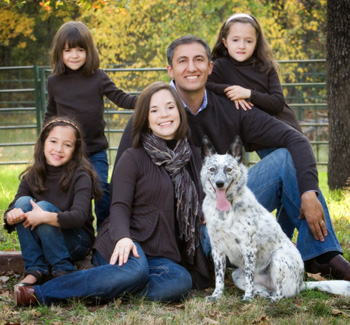
Listener Lori from Garland sent The Wells Report this picture, which poses a very good question for the day.

Tuesday, January 3, 2012

Giovanni Capriglione's Family Dog-Jon-David says he looks like dryer lint

The Capriglione Family along with Family Pooch Doddy
You be the judge.  Sean, Technical Director for The Wells Report thinks Doddy is beautiful and very lucky.  Leave a comment and vote!
Find out more about Giovanni Capriglione and his run for State House District 98 here.

‘Fast and Furious’ Linked to Immunity Deal Between U.S. and Sinaloa Cartel, Trafficking Defendant Alleges in Court Papers

December 29, 2011

(AP Photo/Arizona Daily Star, Greg Bryan)
(CNSNews.com) – An alleged Mexican drug trafficker awaiting trial in a Chicago federal court claims that the notorious Sinaloa cartel received weapons from “Operation Fast and Furious” under an alleged immunity agreement that the U.S. government made with cartel leaders, in exchange for information on rival gangs.
The defendant in a trafficking case before the U.S. District Court for the Northern District of Illinois, Vicente Jesus Zambada-Niebla, also claims the immunity deal allowed the criminal cartel to “continue to smuggle tons of illicit drugs” into the United States.
He wants the U.S. government to provide documents relating to the botched gun running sting operation along the southwest border, arguing that it would benefit his defense.
Operation Fast and Furious, which began in September 2009, saw the Phoenix office of the Bureau of Alcohol Tobacco, Firearms and Explosives supervise the sale of guns to straw purchasers with the intent of tracing the guns to Mexican drug trafficking organizations and prosecuting their members. The ATF allowed about 2,000 guns to be sold in this manner.
The operation came under congressional scrutiny after it was linked to the December 2010 murder of U.S. Border Patrol agent Brian Terry at the hands of Mexican bandits.
An investigative report, spearheaded by Rep. Darrell Issa (R-Calif.) and Sen. Chuck Grassley (R-Iowa), found that most of the weapons provided to Mexican criminals under the operation were going to the Sinaloa cartel, arguably one of the world’s largest drug trafficking organizations.
In a court pleading filed last July, Zambada-Niebla made the claims about an immunity deal.
“Mr. Zambada-Niebla believes that the documentation that he requests will confirm that the weapons received by Sinaloa Cartel members and its leaders in Operation ‘Fast & Furious’ were provided under the agreement entered into between the United States government and [a Mexican lawyer] on behalf of the Sinaloa Cartel that is the subject of his defense …,” it said.
“Mr. Zambada-Niebla believes that the documentation will also provide evidence showing that the United States government has a policy and pattern of providing benefits, including immunity, to cartel leaders, including the Sinaloa Cartel and their members, who are willing to provide information against rival drug cartels.”
The defendant argued that he is protected from federal prosecution for trafficking drugs into the U.S. between 2004 and 2009 under an alleged immunity deal struck between the U.S. government and Sinaloa leaders.
According to court documents, Zambada-Niebla claims that the immunity deal provided the cartel’s leadership with “carte blanche to continue to smuggle tons of illicit drugs into Chicago and the rest of the United States” in exchange for information on rival drug cartels.
U.S. prosecutors deny the existence of such an immunity deal between the U.S. government and the cartel.
Nevertheless, the U.S. government last September filed a motion to invoke the Classified Information Procedures Act, which is aimed at assuring that national security information stemming from criminal cases – such as details associated with CIA operations – are not leaked to the public during court proceedings.
In a court pleading filed in September, U.S. prosecutors claimed that Zambada-Niebla’s allegations about Fast and Furious have no merit.
“Defendant requests all information in the possession of the U.S. government related to an ATF investigation referred to as ‘Fast and Furious’…” it said. “Defendants request related to Fast and Furious … and other unrelated matters are gratuitous and wholly unrelated to any legitimate discovery issues in this case.”
Zambada-Niebla, who was arrested in Mexico in March 2009 and extradited to the U.S. eleven months later, is accused of smuggling tons of cocaine and heroin into the U.S.
He claims he was working on behalf of the U.S. Department of Justice, Drug Enforcement Administration, FBI, and U.S. Immigrations and Customs Enforcement, court documents show.
The defendant’s pleading highlighted a July 2011 letter sent by Issa and Grassley to Attorney General Eric Holder, “suggesting that multiple United States agencies were employing as informants members of Mexican drug organizations.”
“The evidence seems to indicate that the Justice Department not only allowed criminals to smuggle weapons, but that tax payers’ dollars in the form of informant payments, may have financed those engaging in such activities,” the pleading added.

Saturday, December 24, 2011


Next Year’s House 
John Boehner’s job seems safe.
csmonitor.com
For Republicans, 2012 is a year of high hopes and immense possibilities. By this time next year, the GOP could have won the White House and the Senate and kept control of the House of Representatives. But if fortune turns against Republicans next cycle and the White House and Senate escape their grasp, what’s the outlook for the House, the GOP’s last line of defense against a second term of Obama? Republicans currently occupy 242 of the 435 seats; can Speaker John Boehner keep the total above 218?
For now, the outlook for House Republicans is quite healthy. The National Republican Congressional Committee (NRCC) contends that not only are the odds of the GOP keeping the majority extraordinarily high, but they have opportunity to win a sizable number of seats that narrowly eluded them last year.
The first advantage that Republicans see is an essentially unchanged issue environment from 2010. “It’s a cliché that ‘a year is a lifetime in politics,’ but we are still talking about the big issues from 2010,” said NRCC political director Mike Shields on a conference call Wednesday. “Unemployment, spending, debt, taxes — we’re still having that fight. Those issues were huge drivers of votes among both independents and our base voters, and they’re still what we’re talking about — we’re still debating it this week! If the mood of the country shifts or underlying issues change, then the coming year’s election will be different from last year’s, but we seem to be heading into a similar political environment.”
REDISTRICTING
The biggest change from 2010 will be altered district lines in many populous states — minor changes in some, dramatic changes in others. Shields says that the NRCC believes that 15 once-competitive seats have become safely Republican through redistricting.
Pennsylvania appears to be on the verge of finalizing a new map that illustrates the phenomenon well. The Keystone State lost one congressional seat from population shifts in the past decade, and the result is likely to be at least one fewer Democrat in the state’s delegation and several more Republicans with better odds for reelection. In the Cook Partisan Voting Index, Rep. Mike Kelly’s northwestern 3rd district has shifted from R+3 to R+5; Rep. Jim Gerlach’s 6th district has shifted from D+4 to R+1; and Rep. Lou Barletta’s 11th district leaped from D+4 to R+6.
Republican lawmakers achieved this by making some heavily Republican districts less Republican, but still safe (Rep. Bill Shuster’s 9th district, the most Republican in the state, changed from R+17 to R+10) and safe Democratic districts even more heavily Democratic (Rep. Allyson Schwartz’s 13th district shifted from D+7 to D+13) — essentially, moving excess Republicans into swing districts, and moving swing districts’ Democrats into districts that already go Democratic anyway.
“[Democratic incumbents] Mark Critz and Jason Altmire are now drawn into [the] same district, and it’s an R+6,” Shields says. “It doesn’t look like the [former Democratic Rep. John] Murtha district anymore. . . . We feel pretty bullish about Pennsylvania and North Carolina. In one, we shored up some of our members, and we unzipped a ludicrously Democratic map in the other. The most heavily Republican district in that state is [three-term Democratic congressman] Heath Shuler’s.”
The redistricting process is not yet complete nationwide; to the NRCC, the biggest unresolved issues remain in New York, Florida, New Jersey, and Texas.
Adam Temple, a spokesman for the Republican State Leadership Committee, offered perspective on the process so far: “As of today, new maps for 278 of the 435 U.S. House seats have been enacted — although 81 seats are located in states in which [federal] approval of their plans is required under Section 5 of the Voting Rights Act . . . and that approval has not yet been granted. This means that 64 percent of the congressional redistricting is completed. Right now our projection is that the GOP/Democrat box score is a +1, but a more cautious view might be −1.” He also notes that in some states — including New Mexico, Minnesota, Mississippi, Missouri, Illinois, North Carolina, and Virginia — courts are hearing cases that challenge decisions or seek to resolve deadlock.
RECRUITING
Asked which challengers have him particularly excited at this point in the cycle, Shields immediately names Ricky Gill in California. Gill is running against a three-term Democratic incumbent, Jerry McNerney, in the newly drawn 9th district, which comprises parts of San Joaquin County, East Contra Costa County, and southern Sacramento County.
“We came close in the last cycle in this district [McNerney won by one percentage point over Republican David Harmer], and while this district became a little more Democratic in redistricting, it now includes more of the San Joaquin Valley. Ricky is from that part of the district,” Shields says.
Gill, an Indian-American law-school student, will be 25 — the minimum age to serve in the House — on Election Day 2012. In 2004, Gov. Arnold Schwarzenegger nominated Ricky to the California State Board of Education. Following his confirmation by the California state senate, Ricky served as the youngest member of the administration and the sole representative of more than 6 million public-school students.
Shields is also happy to see that several GOP candidates who came close in 2010 are coming back in 2012. “When you have a big wave election, a sort of hangover happens — you see a continuation of momentum some cycles. Some Democrats become not so sure they want to run with Barack Obama; some of our guys feel like they may have missed a good opportunity in 2010.” He mentionsRandy Altschuler in New York, Andy Barr in Kentucky, and Jackie Walorski in Indiana as near-misses who may get over the top with the experience of the previous cycle. Those three lost the closest, fourth-closest, and eleventh-closest House races in the country in 2010.
“We reject the notion that we have to play defense this cycle,” Shields says. “Last year the [Democratic Congressional Campaign Committee] said they were going to play offense, and they ended up playing offense [i.e., funding challenges to incumbent Republicans] in two districts. This year, we think we’re in 14 districts where we have solid races, and we could get to 17–18 by the time we’re done.”
THE PRESIDENTIAL RACE’S IMPACT
On paper, a high-stakes presidential campaign should bring out each party’s base and create potential trouble for red-state Democrats and blue-state Republicans. But Shields says he’s actually more worried about what he calls “orphan states” — ones that are considered not competitive in the presidential race, and thus are less likely to see considerable investment from other party committees and grassroots groups.
California, Illinois, and New York — those are states where we have competitive offensive opportunities, but we need to create the infrastructure,” Shields says. “In the last 20 years in California, there have hardly ever been any competitive races. This cycle, we could have eight, nine, maybe ten competitive races there.” By contrast, House Republicans in states such as Ohio, Colorado, and Wisconsin will be helped by the expected furious get-out-the-vote campaigns by the Republican nominee’s campaign and its allies, and of course will face similar efforts from the Obama campaign and its allies.
“When we won our majorities, we did not win with a bunch of swing-y states that go with the tide,” Shields said. “We won our majority by winning a lot of Republican seats that we really never should have lost,” pointing to seats in conservative, often rural regions in places such as Alabama, Missouri, and Arkansas. “These are ones that are never going back. Our map is built on those types of districts, and through redistricting, we’ve been able to strengthen some of those marginal seats.”
Clichés about quick reversals of fortune in politics are cited for good reason, but for now, in an election cycle marked by continued debate about anxiety about employment, the political leader in Washington with the best odds of keeping his job might be House Speaker John Boehner.
— Jim Geraghty writes the Campaign Spot on NRO.


News/Talk 660 K-SKY | 6400 Belt Line Road, Suite 110 Irving, Texas 75063 | (214) 561-9660