Tuesday, December 20, 2011

Santa stops by The Wells Report!!

en.wikipedia.org


Santa Claus stops by The Wells Report !!!

Mrs. Claus has given him permission to give out her very favorite Christmas Cookie Recipe: Santa's Whisker Cookies


"Santa'sWhisker's" cookies

Makes 60 cookies • From the kitchen of Elf Meagan & Mrs. Claus

Ingredients

3/4 cup (1 1/2 sticks) margarine 
2 cups flour 
3/4 cup sugar 
1 tablespoon milk 
1 teaspoon vanilla 
3/4 cup finely chopped candied red or green cherries 
1/3 cup finely chopped pecans 
3/4 cup coconut 

Directions

1.              Beat margarine with an electric mixer on medium to high speed for 30 seconds.
2.              Add about half the flour, also add sugar, milk, and vanilla.
3.              Beat till thoroughly combined.
4.              Stir in remaining flour, cherries and pecans.
5.              Shape into 8-inch long rolls.
6.              Roll in coconut.
7.              Wrap in wax paper; chill 2- 24 hours.
8.              When ready to bake, preheat oven to 375 degrees F.
9.              Cut dough into 1/4-inch slices.
10.        Place on an un-greased cookie sheet, for 10-12 minutes or until the edges are golden.
11.        Cool cookies on a wire rack.

Republicans in House Reject Deal Extending Payroll Tax Cut

Stephen Crowley/The New York Times

Jon-David talks to Congressman Michael Burgess at 5:35P CT TODAY!!!!


By BRIAN KNOWLTON
Published: December 20, 2011

WASHINGTON — House Republicans on Tuesday soundly rejected a bill approved by the Senate that would have extended the payroll taxcut for most Americans beyond the end of the year and allowed millions of unemployed people to continue receiving jobless benefits.

The House vote, which passed 229 to 193, also calls for establishing a negotiating committee so the two chambers can resolve their differences.  Seven Republicans joined Democrats in opposition.
But the Senate has left town for the year, and Democrats say they do not intend to call it back, putting continuation of the tax cut in jeopardy and leaving a shadow over many unemployed Americans as the holidays near.
It was far from clear whether the two sides would be able to bridge the gap by year’s end. If they fail to do so, payroll taxes for 160 million Americans will rise to 6.2 percent, from 4.2 percent, in January, for an average annual increase of roughly $1,000.
Republicans said the two-month extensions provided by the Senate bill left too much uncertainty at a time of deep economic vulnerability and would leave Congress facing the same thorny issues early in the new year. They said it was a deeply inadequate half-measure that represented the old ways of Congress. 
Immediately after the vote, Speaker John A. Boehner released a letter to the president, saying that he agreed with Mr. Obama on the need for a full-year extension of the tax cut and unemployment benefits.
“There are still 11 days before the end of the year, and with so many Americans struggling, there is no reason they should be wasted,” Mr. Boehner wrote. “You have said many times that Congress must do its work before taking vacation.  Because we agree, our negotiators and the House stand ready to work through the holidays.  I ask you to call on the Senate to return to appoint negotiators so that we can provide the American people the economic certainty they need.”
But in a surprise appearance in the White House briefing room immediately after the vote, President Obama called on House Republican leaders to approve the Senate bill, saying that it was the only way forward.  Without such action, the president said, not only would taxes go up and millions of Americans would lose their unemployment benefits, but the economy would suffer as paychecks shrunk.
“Right now, the bipartisan compromise that was reached on Saturday is the only viable way to prevent a tax hike on Jan. 1 — it’s the only one,” Mr. Obama said.
Speaking with somber intensity, Mr. Obama, who had just returned from a ceremony at Andrews Air Base marking the end of the Iraq war, said that the stakes for Americans were high. “This is not poker, this is not a game, this shouldn’t be politics as usual,” he said.
“The recovery is fragile but it is moving in the right direction,” Mr. Obama said, adding that failure to act quickly “could have an effect on the economy as a whole.”
“The clock is ticking, time is running out, and if House Republicans refuse  to vote for the Senate  bill or even allow it to come up for a vote, taxes will go up in 11 days,” the president said.
Rather than have a straight up-or-down vote, the House on Tuesday implemented a procedural maneuver in which it “rejected” the Senate bill while requesting to go to conference with members of that chamber in a single measure, protecting House members from having to actually cast a politically unpopular vote against extending a payroll tax cut.
Before the vote, Representative Jeb Hensarling of Texas, a member of the House Republican leadership, said on CNN that “House Republicans stand ready to work over the holidays, like many other Americans have to do, to get this done.”
Democrats, seeming to feel the political wind at their back, said the other party had missed its best chance to protect the economic interests of the middle class.
The bill that the Senate passed on Saturday, in an 89-to-10 vote, would also prevent a sharp cut in the fees paid to doctors who accept Medicare. Some Republican senators, including Senator Scott P. Brown of Massachusetts and Senator Richard G. Lugar of Indiana, have called on their counterparts in the House to support that vote.
Representative Nancy Pelosi of California, the House Democratic leader, blaming “the extreme Tea Party element of the Republicans in the House,” noted during the floor debate that Republicans had said a two-month extension was too short. “They’ve never wanted a tax cut, and now they’re saying the tax cut for middle-income people is too small,” she said. “So what is it?”

With tempers growing short and pressure rising for a deal, Representative Eric Cantor of Virginia, the House Republican leader, seemed to strike a particularly conciliatory tone.
“We need to come together in a responsible manner to find common ground where we can accomplish everyone’s goal of a year-long payroll tax extension,” Mr. Cantor said during the floor debate. “Mr. Speaker, there is no reason why the House, the Senate and the president cannot spend next two weeks working to get that done. America will be waiting.”
Senate Democrats, however, have said they would not return to the Capitol to negotiate further until the House passed the short-term bill, one that Senator Mitch McConnell of Kentucky, the Republican leader, negotiated and voted for, along with 38 other Republican senators on Saturday.
The House had been planning to vote on the two-month payroll tax bill on Monday night. But after a two-hour meeting of their caucus, House Republican leaders postponed the floor debate and the vote to Tuesday.
During the conference meeting among Republican members, some members expressed concern about effectively voting for a tax increase on the eve of an election year, said some who attended.
The standoff leaves Mr. Boehner ending the year exactly where he began, in the middle of a nasty fiscal fight with Senate Democrats and his conservative freshmen in revolt, making it difficult to find a middle ground between mollifying his conference and coming up with legislation to avert disaster. But Mr. Boehner said repeatedly on Monday that he believed a deal for a one-year extension could still be struck, even with the Senate essentially adjourned for the year and the tax break set to expire on Jan. 1.
“I don’t believe the differences are that significant that we can’t do this for a whole year,” Mr. Boehner said. “Why punt this until the end of February when we can just do this now and get it over with?”
Senator Harry Reid, the Nevada Democrat and majority leader, urged Mr. Boehner to allow an up-or-down vote. ”With millions of Americans struggling to make ends meet, it would be unconscionable for Speaker Boehner to block a bipartisan agreement that would protect middle-class families from the thousand-dollar tax increase looming on January first,” Mr. Reid said in a statement.
Jennifer Steinhauer and Robert Pear contributed reporting.
Story Here


http://www.weeklystandard.com

A Picture of Syrian Protesters in an article dated Monday December 19, 2011  The original story reports, "5,000 Syrians have been massacred by Bashar Assad since March, including 300 children.  How are those sanctions workin' out, Mr. Obama?


Monday, December 19, 2011

Looking for Inflation? It’s Hiding in Smaller Package Sizes


frugallawstudent.com

By Len Penzo-Money Talks News

Inflation? What inflation?

The fact is, for those who are willing to look close enough, we’re actually being confronted by a serious bout of deflation - at least when it comes to the size of the containers sitting on our supermarket shelves.

With prices continuing to rise in the face of the depressed economic climate, manufacturers continue to find themselves caught in a classic dilemma: either raise prices and risk losing customers, or stave off the price increase by shrinking the size of their packaging ever so slightly.

Anybody care to guess which option the company brass most often decides to take when faced with the need to make that kind of lose-lose decision?

The Evidence is All Around You

Although I can’t prove it, I suspect the majority of manufacturers ultimately decide that a little deception is worth it if it means they can hold back those dreaded price increases.

A recent article on this topic in The New York Times provides plenty of circumstantial evidence. For example…
·                          Chicken of the Sea tuna now comes in 5-ounce cans, as opposed to the traditional 6-ounce containers
·                          Doritos, Fritos, and Tostitos reduced the quantity of chips in their bags by 20 percent
·                          Tropicana recently dropped their orange juice carton size from 64 to 59 ounces
·                          Nabisco’s Premium saltines and Honey Maid grahams have new packaging with 15 percent fewer crackers

Don’t be Too Hard on the Manufacturers

Despite all of these examples, I don’t really think this is a case of manufacturers trying to make a fast buck on the consumer.

Historically, manufacturers have been raising and lowering package sizes in order to keep from raising prices for a long, long time. For example, Hershey has been altering 
the size of their candy bars to account for fluctuating ingredient costs from as far back as 1908.

Between 1921 and 1968 the price of a Hershey chocolate bar held steady at a single nickel. During that time, the weight of the bar fluctuated — in both directions — from a high of 2 ounces in 1930 to a low of 0.75 ounces in 1968.

And while you may be annoyed that manufacturers surreptitiously reduce package sizes in order to hold prices steady, they’re not the ones who are instituting the monetary policies that have led to the current bout of inflation.

To be sure, inflation is getting so bad now that I see even TP isn’t immune from package downsizing. In their own study of shrinking package sizes, Consumer Reports found that a roll of Scott toilet paper – excuse me, toilet tissue – has 
9 percent less paper on a roll than it used to.

Hey, it could be worse. Scott could have tried holding prices down by going from 2-ply to 1-ply instead. Or even 1.3-ply.

Then again, I suspect that type of deception is something most of us would have noticed sooner rather than later.

Original Story Here.

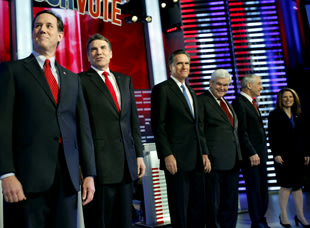
What now? Why the next 10 days are the most critical of the GOP campaign


By Holly Bailey-Senior Political Reporter

Six months ago, political junkies were deriding this year's Republican presidential race as one of the 
slowest and least exciting nomination battles in recent memory.  Mitt Romney looked hard to beat.  Newt Gingrich's campaign appeared all but dead.  And several key Republicans whom many party outsiders had begged to run-including Chris Christie, Mitch Daniels, Mike Huckabee and Haley Barbour-opted out of the campaign.
Yet that boring Republican race has turned into one of the most unpredictable and chaotic presidential nominating contests in party history. With voting set to begin in a little over three weeks, the race now enters its most crucial phase. Republican voters in the early states will finally have to decide who they want to represent their party against President Obama.
Charlie Neibergall (AP)
The next 10 days will be the most critical of the campaign, as the candidates begin to make closing arguments to Iowans before most voters tune out the campaign during the Christmas holidays.
Newt Gingrich, who leads in the polls in three of the four early nominating states (Iowa, South Carolina and Florida--he trails only in New Hampshire), faces the most pressure. He must translate his surge in the polls into actual wins.
"If Gingrich can survive this week and next week, he may be OK," Warren Tompkins, an influential South Carolina-based Republican strategist, told Yahoo News. "All he needs to do is make it through that lull through the holidays."
The former House speaker largely fended off attacks from his rivals at Saturday's Iowa debate, sponsored by ABC News and Yahoo News. But the clashes hinted at Gingrich's biggest enemy: Gingrich himself.
His more than three decades in the public eye have already provided plenty of fodder for attack ads from his rivals, including Romney and Ron Paul. Scrutiny of Gingrich's record and his personal life—including two failed marriages that ended, in part, because he cheated—is likely to increase in coming days.

On Saturday, Gingrich coolly dispatched his rivals' attempts to attack his record. ("Let's be candid: The only reason you didn't become a career politician is you lost to Teddy Kennedy in 1994," Gingrich replied when Romney described him as a creature of Washington.)

For Romney, the stakes are equally high, as he is now in virtually the same position he was four years ago, when he was an early frontrunner for the Republican nomination but lost ground in the polls as the Iowa caucuses approached. In trying to contain Gingrich's surge, the Romney team is using the same playbook they used in 2008 when they tried to take down Mike Huckabee's insurgent candidacy, by carpet-bombing TV and radio with negative ads.
That approach backfired for Romney four years ago—and could do so again. Many Republican voters remain skeptical about Romney, polls show. For months, the race has been about voters looking for an alternative to the former Massachusetts governor, with Gingrich being the latest candidate to rise into that role.
If Gingrich falters, there are others who could step into his shoes. Rick Perry, who raised a lot of money before his campaign faltered this fall, is spending millions of dollars on TV ads in Iowa and seems to have finally found his footing in the debates—though it may be too late. Michele Bachmann and Rick Santorum are trying to fight not only for the divided support of social conservatives in Iowa, but also for Herman Cain's supporters, who are now looking for a new candidate in the race.
The biggest question mark in Iowa could be Ron Paul, who has steadily risen in the polls in the state in recent weeks and has been drawing the biggest crowds of the 2012 contenders there. Paul's candidacy has been dismissed by many mainstream Republicans, but he is second only to Romney in his ability to raise campaign cash, which makes him a very real player in the race.
Adding to the chaos and uncertainty of the primaries are factors that weren't in place four years ago, including super PACs that have already spent millions on TV ads to boost specific candidates and attack others. In New Hampshire, Jon Huntsman, a moderate Republican who is aiming for a surprise showing in the state, is being aided by a super PAC funded by his father.
The way the race looks today could be completely changed by the time voters head to the polls. Iowa and New Hampshire are home to voters who are known for being late deciders and for changing their minds at the last minute. In January, those voters could break for anyone.

Original Story Here.


News/Talk 660 K-SKY | 6400 Belt Line Road, Suite 110 Irving, Texas 75063 | (214) 561-9660