Thursday, October 6, 2011

Herman Cain: What's behind his rise in the polls?

By Peter Grier, Staff writer 
posted October 4, 2011 at 5:35 pm EDT
from: http://www.csmonitor.com/

There's been a clear upturn in the numbers for Herman Cain starting about the middle of September, which is just when Rick Perry’s polls began to sag.

Herman Cain has leapt into the top tier of GOP presidential candidates, in case you haven’t heard. In the ABC News/Washington Post poll released Tuesday, Mr. Cain is tied with Texas Gov. Rick Perry for second, at 14 percent of Republican-leaning voters. That’s bad news for Governor Perry, but great news for the Hermanator, whose numbers have generally been described by single digits since the 2012 race began in earnest.


What’s going on here? Why the sudden rise? Well, for one thing, Cain appears to be the anti-Perry. That means that where Perry has declined since voters began to see and hear more about him in GOP debates, the opposite dynamic has occurred with the ex-Godfather's Pizza exec. He’s wearing well with the Republican base.

Look at the RealClearPolitics rolling average of polls, and you can see a clear upturn in Cain’s numbers starting about the middle of September, which is just when Perry’s polls began to sag. In particular, Cain’s rating has shot up in recent days, since he won a Sept. 24 Florida straw poll. Perry’s line has plummeted at the same time.

Confirmation of this comes with Gallup’s new Positive Intensity Score numbers, which are created by subtracting the percentage of strong opponents of a particular candidate from the percentage of strong supporters. Cain’s POS is now 30, the highest for any GOP candidate this year.

“Cain’s straw poll win, and his resulting gains in recognition and positive intensity, may have made him a legitimate contender for the Republican nomination in Republicans' eyes,” writes Gallup analyst Jeffrey M. Jones.

So what’s next? Is Cain going to peak and fade, as have both Michele Bachmann and Perry?

Cain himself pushed back against the idea Tuesday morning in an appearance on “Fox & Friends.”

“Black walnut isn’t a flavor of the week,” he said.

But Cain now faces clear problems as he breathes the rarefied air of the GOP top tier.

The first is that he’s likely to get a lot more attention. That’s good, in the sense that his still-low name recognition will go up. But it could be bad if he gets the punishing attacks from GOP rivals that have nicked Representative Bachmann and (especially) Perry.

The media may also delve more deeply into his background. “Cain will have to weather the next few debates and the next few weeks of campaigning if he is to solidify a position as a leading contender for the nomination,” writes Mr. Jones of Gallup.

The second problem is how to expand his support in early primary states. Though data on this are sketchy, it appears much of Cain’s support comes from Southern states. A recent InsiderAdvantage survey showed him with a huge lead in his home state of Georgia, for instance – 41 percent.


In Florida, a SurveyUSA poll puts him right on Mitt Romney’s heels. The latter leads with 27 percent of the vote. Cain follows closely at 25 percent.


But what about Iowa, where next year’s caucuses will kick off the real voting? Currently, the RealClearPolitics state rolling average puts Cain in fifth in Iowa, with only 5.3 percent of the vote.


Cain’s numbers are even worse in New Hampshire. RCP puts him dead last there, as the choice of only 2.7 percent of voters.


Now, state polling can be much less accurate than national surveys, and some of the polls included in the Iowa and New Hampshire averages are dated. It’s possible Cain has already risen in the early voting states, and we just don’t know it yet. It’s also possible that Cain is simply something of a Southern favorite son candidate.

Wednesday, October 5, 2011

Jon-David will be at the Mid-Cities Greek Food Festival this Friday


St. John the Baptist • Greek Orthodox Church
303 Cullum Drive • Euless, TX 76040
817.283.2291 • www.stjohndfw.info


Jon-David at the Trophy Club Salutes Wounded Warriors Project

Jon-David went out to help raise money for the Trophy Club Salutes Wounded Warriors Project last Friday.  Check out the Pictures courtesy of Denise Albini

SGT 1st Class (ret) Dana Bowman and Jon-David


SGT 1st Class (ret) Dana Bowman and Jon-David


 Jon-David and the Mavs Dancers

Jon-David and SGT Johnathan Reyna facilitator/sports trainer at Marine Corp regiment WWP in San Antonio.


Color Guard with the Marine Corp and American flags getting ready for the National Anthem.  Jon-David on the Mic


Gene Popik, President of Trophy Club Salutes Wounded Warriors, Inc. 501 C-3 reading a letter from former President GW Bush


Heuy hovering over the crowd

Tuesday, October 4, 2011

Some Couples Pull Back From the Edge of Divorce-Because of Economy

Courtesy of http://www.oddstuffmagazine.com/
By Sharon Jayson, USA TODAY

They were a few steps shy of divorce, separated and working out child custody, when Rick DeRosia of Hartford, N.Y., realized he wasn't so sure he really wanted a divorce.

He says his 16-year marriage had been shaky before the separation in 2009, when he told his wife, Tina, he wanted out. Their son and daughter were 13 and 11. And life in the midst of recession was also taking a toll.  "There wasn't any one event," says Rick DeRosia, 42. "It was several things over the years that started a downhill slide that never really came back up."  Divorce "was not really what I wanted," says Tina DeRosia, 38, but she thought he did. "I felt moving on was what I needed to do, but … should we try to do more? I thought about the effect it would have on my children."

The DeRosias, like so many couples, were teetering on the brink of divorce. The angst of such a major decision is very real. But little is known about how people actually decide — or why, like the DeRosias, they sometimes change their minds. New research offers the first inklings of understanding — and shows that there's uncertainty even among couples who have already filed for divorce.

Adding to the confusion is the financial reality that a split is expensive. Census data released last week suggest that the economy has indeed caused a dip in divorce. Some experts predict a divorce explosion when the economy improves, but others say the recession may keep some together long enough to work it out.

"There's a whole lot more ambivalence out there than any of us ever thought," says psychologist William Doherty, a marriage and family therapist and professor of family social science at the University of Minnesota. He'll present results of his survey in Washington next month, expanding on his research published last spring.

Frank and Julie LaBoda of Cross Plains, Wis., were just weeks from a divorce decree that would have ended the marriage that began Aug. 7, 1992. "All that fun stuff was gone," says Frank LaBoda, 46, a transportation operations manager, who says his wife was so busy with the kids that he started spending more time with the guys. Then he had an affair and moved out for six months. That was in 1996.

"We tried to put it back together after the affair, but it was ugly," says Julie LaBoda, 44, a dental assistant.
Two years later, she filed for divorce, and they separated for another six months. But they opted for a last-ditch marriage weekend that they say saved their relationship.  'Forgiveness and hope'

"We found out that forgiveness and hope was possible and that people can and do change. We saw real-life examples of people who shared stories with us. Frank changed his behavior drastically, and I'm quite sure I changed my attitude," she says. "But it was a process to get through it — a good, solid two to five years." In 2000, they had a third child; their fourth daughter was born in 2002.

Doherty's survey of 2,484 parents who filed for divorce in Minnesota offers new insight into how people decide whether to call it quits or try again. About a quarter of those surveyed thought there was still hope for the marriage; in 12% of a subset of 329 couples, both partners independently indicated interest in reconciliation.

Additional surveys in 2009-10 of 886 Minnesotans who filed for divorce dug deeper into contributing factors. "Growing apart" was the top reason, cited by 55%, followed by "not able to talk together" (53%). Infidelity was cited by 34%, the same percentage who cited "not enough attention."

Doherty says lack of attention from one's spouse and in-law problems were among reasons associated with partners thinking the marriage could be saved. Also, infidelity wasn't a factor in whether someone was open to reconciliation, he says.

Alan Hawkins, a professor of family life at Brigham Young University in Provo, Utah, says there's a lot of research on factors that predict divorce but "virtually no research on the thinking process."

Iris Krasnow interviewed more than 200 women for her book, The Secret Lives of Wives: Women Share What It Really Takes to Stay Married. "Splitting up crosses people's minds more than I imagined," she says. And "those on second marriages were not any happier than they were in their first. Many times, you're trading in one set of problems for another."

Doherty says marriage today involves expectations of more gender equality than in the past. "We expect so much out of marriage, but we haven't prepared people for the skills that are necessary for the kind of marriages that we want now."

Denver clinical psychologist Susan Heitler says couples often view her as "a last resort." But "it's radically cheaper emotionally, as well as financially, to fix the marriage than to declare it dead," she says.  The Census bureau counted 65,000 fewer divorces in 2010 than in 2008, a 7% drop. Observers say tough economic times mean many delay divorce; it's expensive to maintain separate households and pay attorney costs. It also may be difficult to sell the house to divide assets.

Of the more than 1,600 member lawyers surveyed in the past month by the American Academy of Matrimonial Lawyers, 85% say they've seen a rise in divorce settlement complications over housing debt in the past three years; 53% have seen an increase in the number of child custody cases involving relocation requests.

Economy takes a toll

Matt O'Connor, 40, of Atlanta shares custody of his kids, 11 and 4. His former wife moved to Phoenix a week before the divorce was final in July.

He believes the economy took a toll on his 12-year marriage.

"We had a business that was an early casualty of the recession. She found full-time work, but that business, after a couple of years, closed. She was one of the last people on staff; it was very stressful. When she couldn't find work, she tried to start a new business, and that ultimately failed as well," he says. "There was a tremendous amount of difficulty outside the marriage that ultimately impacted the marriage."

He says they couldn't sell the house, and his ex couldn't afford to move out, so they lived together until she left town.

Brandon and Erin Hamilton of Modesto, Calif., say they spent $15,000 to $20,000 for lawyers and other divorce costs — but ended up not going through with it. They married in 2005. The troubles started in October 2008, when she was on maternity leave from her job as a registered nurse.

"My husband took a 40% pay cut the month my first daughter was born," says Erin Hamilton, 29. "He didn't want to tell me about the pay cut. It just turned into this massive snowball."

He filed for divorce. Custody of their infant daughter became a major issue, both say. "In the process of getting my teeth kicked in in court, I was second-guessing myself," says Brandon Hamilton, 40, which prompted him to try reconciliation. "When I walk my daughter down the aisle, I wanted to be able to tell her that I tried everything."

They went to classes to bolster communication and conflict resolution, which she says helped when their home went into foreclosure.  The couple had another daughter three months ago.

The DeRosias, both certified nurse assistants at the same nursing home, were separated a couple of months and had both been dating others when a series of events changed their course toward divorce. A car breakdown and not enough money to fix it meant they shared rides to and from work for a week and spent extra time together during that period. He realized he was jealous of her new boyfriend. And then he says a song on the radio "hit an emotional chord with me."

Every Other Weekend, a Reba McEntire and Kenny Chesney song about the kid trade-off, brought them back together, he says. "I had the song on the radio and asked her if she would take me back," he says. "I don't know if that time apart was necessary for me to realize it, but I had more fun with her that week than I had in years. I realized I wanted to try again."

Monday, October 3, 2011

Obama Struggling to Retain Jewish Vote

By Gabriella Schwarz, CNN
Wed September 21, 2011

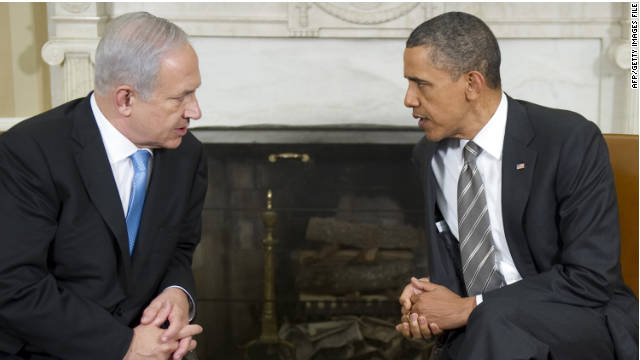
Israeli Prime Minister Benjamin Netanyahu with President Obama Courtsey of CNN
Jewish voters, a typically reliable bloc for the Democratic Party, are now the focus of Democrats intent on keeping their support and Republicans who see an opportunity to pull them in after New York's recent special congressional election.

Longtime New York Democratic strategist Hank Sheinkopf said the election, in which a Republican won the historically Democratic district, was in part a reaction to the president's approach to Israel. Sheinkopf said the contest served as a "liberating device" for Jewish voters and not just Orthodox Jews, who tend to be more socially conservative.  "It is very unlikely he gets large portions of the pro-Israel community back; it's too late. Something extraordinarily miraculous would have to occur," Sheinkopf said. "There is a general sense of betrayal that this guy just doesn't understand who these Jews are.  "He got his first warning," Sheinkopf added.  Signs of tension between the president and Jewish supporters surfaced before the New York election and are heightened with the spotlight on the annual meeting of the United Nations General Assembly in New York, in which Palestinian Authority President Mahmoud Abbas is expected to submit an application for statehood to the Security Council.

Will the GOP push for Jewish votes pay off?  The Obama administration has vowed to veto the submission, affirming its longstanding backing for Israel, America's strongest Middle East ally.  But many Jews were angered over President Obama's May speech in which he suggested that Israel return to pre-1967 borders with land swaps agreed upon by Israelis and Palestinians. The pre-1967 borders refer to Israel's territory before the Six-Day War that year, in which Israel captured Gaza, the West Bank, East Jerusalem and other territory from neighboring countries.

Israelis argue that returning to the former configuration would leave population centers vulnerable and displace settlers.

The president's statements were followed by an awkward meeting with Israeli Prime Minister Benjamin Netanyahu, in which Netanyahu seemingly lectured Obama in the Oval Office, vowing that Israel would never return to the 1967 lines.

In New York, Republican Bob Turner's 8-percentage point victory over Democrat David Weprin in a district held by Democrats since 1923 brought a new focus on Jewish voters, who supported Obama's presidential bid by an overwhelming 78% in 2008.  The Democratic loss in the highly Jewish 9th congressional district comes as Obama's polling numbers among Jewish voters, nationally and in New York, have declined. Rep. Anthony Weiner held the seat until he resigned in June after exchanging inappropriate images over social media.

Fifty-four percent of Jewish Americans approved of Obama's performance as president in September, compared with 60% in June and 68% in May, according to Gallup polling.

A statewide New York poll taken by Siena College in August found Obama's approval at 52% among all Empire State voters and at 49% among the state's Jewish voters. Although Obama received a 67% approval rating among Democrats in the state, he garnered 49% approval from Jewish Democrats.

Steve Greenberg, the Siena political poll spokesman, said that the president's poll numbers "should be better among Jewish voters" and that last week's election proved that there are no safe districts for the president.  "Even in a safe Democratic district, Obama is not safe, and therefore he clearly has his work cut out for him," Greenberg said.  However, he said voters are looking at the president in a vacuum instead of against a Republican challenger, when he is likely to fare better, and he cautioned against using the special election as a barometer for the rest of the country.

"There are issues he's got to work on over the next 14 months, but it's not a crisis situation," Greenberg said, pointing to the uniqueness of the district's religious electorate, a third of whom are Orthodox Jews, and the heavy role Middle East politics played in the race.

CNN exit polling says the national Jewish vote has not surpassed 4% of the total vote in the past five presidential elections. However, a higher concentration of the Jewish population in key presidential voting states, including New York, New Jersey and Florida, could prove important for Democrats and Republicans in 2012.

Matt Brooks, executive director of the Republican Jewish Coalition, said the Obama administration's policies toward Israel have left Jews "concerned" ahead of the presidential election. He cited the president's criticism of Israeli settlements, his disapproval over construction in Jerusalem and the 1967 border call as reasons for the ill will.

"Because of the failed policies and the harsh criticism as it relates to Israel, (Obama has) got a real problem with Jewish voters across the country," Brooks said, calling the New York election a bellwether for the rest of the country over Israel and the economy.  "I'm confident that Republicans will continue to make inroads in 2012 in the Jewish community ... as Jewish voters move away from the Democratic Party," Brooks said.

On the other side of the aisle, the Democratic National Committee and the Obama White House are ramping up outreach efforts.  In an e-mail to Jewish supporters, Ira Forman, Jewish outreach director for the Obama campaign, sought to "set the record straight."

"The other side is working hard to distort the President's record, particularly when it comes to his strong support of Israel," Forman wrote. "To set the record straight, it'll be up to supporters like us who know the truth to get the word out."

Ben Rhodes, deputy national security adviser for strategic communications at the White House, said the U.S. and Israel have stood together in "unprecedented ways" during the Obama administration. At the White House on Friday, Rhodes said the United States has lent military assistance to Israel to protect itself from incoming missiles and rockets and stood up against the de-legitimization of Israel at the U.N., among other steps.  "We've got a very strong record of support for Israel that should be evident to anybody who shares our concern for the future security and prosperity of Israel," Rhodes said. "The security cooperation is evident; the de-legitimization efforts by us to counter those de-legitimization efforts are evident."

Alan Solow, an outside adviser to the Obama campaign on Jewish issues, said the president's political opponents are mischaracterizing his record on the Middle East.  "We ... need to fight back against those misrepresentations and clarify the record," Solow said. "We'll go through some ups and downs as events occur, but I think in the end, our belief is that his percentage of the Jewish vote in 2012 will be very similar to what it was in 2008."

David Harris, the executive director for the nonpartisan American Jewish Committee, doled out advice to Democrats and Republicans angling for Jewish support.  "Democrats need to better explain their Middle East positions to ensure that their support in the Jewish base does not wane, Harris said.  "They need to tell the story better," Harris said. "Don't take your Jewish base for granted."  Meanwhile, Harris said, Republicans have an opportunity to make inroads in the Jewish community through an economic plan and Middle East policy.  "Jews are multi-issue voters. The notion they are single-issue voters is simply wrong," Harris said. Jewish voters "want to have a comfort level they want to believe in their kishkas, in their gut, that the person gets Israel, understands it, grasps why Israel is important to the United States."


News/Talk 660 K-SKY | 6400 Belt Line Road, Suite 110 Irving, Texas 75063 | (214) 561-9660